On this page
AS9100 Rev D, NADCAP, and ASME Y14.5 are three of the most important standards in aerospace manufacturing. AS9100 ensures a robust quality management system, NADCAP validates special manufacturing processes, and ASME Y14.5 defines geometric dimensioning and tolerancing (GD&T) requirements. Together, they help aerospace manufacturers produce highly reliable, traceable, and precision-engineered components that meet stringent industry requirements.
Introduction: Why a Few Microns Can Ground an Aircraft
Imagine an aircraft engine component machined only 0.05 mm outside its specified tolerance. To the naked eye, the part may appear perfect. However, under operating temperatures exceeding 600°C and rotational speeds reaching thousands of RPM, that tiny deviation can lead to vibration, premature wear, or catastrophic failure.
This is why aerospace manufacturing operates differently from most industries. Every component, every process, and every inspection activity must comply with rigorous standards designed to ensure safety, reliability, and performance.
Three standards form the foundation of modern aerospace manufacturing:
- AS9100 Rev D.
- NADCAP.
- ASME Y14.5 GD&T.
Understanding how these standards work together is essential for aerospace OEMs, Tier-1 suppliers, and contract manufacturers seeking to deliver world-class aerospace components.
What Is AS9100 Rev D?
AS9100 Rev D is the internationally recognized Quality Management System (QMS) standard specifically developed for the aerospace, aviation, and defense industries.
While based on ISO 9001, AS9100 introduces additional aerospace-specific requirements, including:
- Product safety
- Risk-based thinking
- Counterfeit part prevention
- Configuration management
- Supply chain control
- Traceability requirements
Why Is AS9100 Important?
Aircraft manufacturers cannot afford inconsistent quality.
AS9100 helps manufacturers establish processes that ensure:
✓ Repeatable production quality
✓ Reduced defects
✓ Improved supplier management
✓ Enhanced risk mitigation
✓ Full material traceability
For aerospace OEMs, AS9100 certification is often a prerequisite before a supplier can even be considered for a project.
What Is NADCAP Certification?
Understanding Aerospace Special Processes
Many aerospace components undergo processes that cannot be fully verified through final inspection alone.
Examples include:
- Heat treatment
- Welding
- Chemical processing
- Coating
- Non-destructive testing (NDT)
- Surface treatment
These are known as special processes.
NADCAP (National Aerospace and Defense Contractors Accreditation Program) validates that these processes are performed consistently according to aerospace industry requirements.
Why Aerospace OEMs Prefer NADCAP Suppliers
A NADCAP-accredited supplier demonstrates:
- Process capability
- Personnel qualification
- Equipment calibration
- Process validation
- Continuous compliance monitoring
For aerospace procurement teams, NADCAP reduces supplier risk and ensures process integrity throughout production.
How Do AS9100 and NADCAP Work Together?
Many organizations mistakenly believe AS9100 and NADCAP are interchangeable.
They are not.
| Standard | Focus Area |
|---|---|
| AS9100 Rev D | Overall Quality Management System |
| NADCAP | Special Process Validation |
| ASME Y14.5 | Engineering Drawing & Tolerance Definition |
Think of them as three layers of aerospace quality assurance.
AS9100 ensures the organization has robust systems.
NADCAP ensures critical manufacturing processes are controlled.
ASME Y14.5 ensures engineers communicate requirements accurately.
Together they create a complete framework for aerospace manufacturing excellence.
What Is ASME Y14.5 and GD&T?
ASME Y14.5 is the industry standard governing Geometric Dimensioning and Tolerancing (GD&T).
GD&T is a symbolic language used on engineering drawings to define:
- Form
- Orientation
- Location
- Profile
- Runout
Instead of relying solely on traditional plus/minus dimensions, GD&T allows engineers to communicate design intent precisely.
Why Is GD&T Critical in Aerospace Manufacturing?
Aerospace assemblies often contain hundreds or thousands of interacting components.
Even minor dimensional variation can create:
- Assembly issues
- Misalignment
- Fatigue failures
- Increased vibration
- Reduced performance
GD&T helps manufacturers achieve:
Improved Fit and Function
Components assemble correctly the first time.
Reduced Manufacturing Cost
Engineers can optimize tolerances instead of over-constraining dimensions.
Better Quality Control
Inspection teams have clearly defined acceptance criteria.
Enhanced Interchangeability
Replacement parts fit regardless of manufacturing batch.
Key GD&T Concepts Every Aerospace Supplier Must Understand
Datum Reference Frames
Datums establish the coordinate system used for measurement.
Without datums, inspection results can vary significantly.
True Position Tolerance
True Position controls the exact location of holes, slots, and features.
This is one of the most commonly used GD&T controls in aerospace machining.
Profile Tolerance
Profile controls the shape of complex surfaces such as:
- Airfoils
- Engine housings
- Structural brackets
Profile tolerances are especially important in aerospace applications involving aerodynamic performance.
Flatness and Perpendicularity
These controls ensure proper mating surfaces and assembly alignment.
Failure to control these characteristics can lead to:
- Seal failures
- Assembly issues
- Increased stress concentrations
What Tolerances Are Common in Aerospace Machining?
Tolerance requirements vary based on application.
Typical aerospace machining tolerances include:
| Feature Type | Typical Tolerance |
|---|---|
| General CNC Machining | ±0.050 mm |
| Precision Features | ±0.025 mm |
| Critical Aerospace Components | ±0.010 mm |
| High Precision Features | ±0.005 mm |
For turbine engine and flight-critical applications, tolerances can be even tighter.
Achieving these tolerances often requires:
- 5-axis CNC machining
- Advanced fixturing
- Temperature-controlled inspection
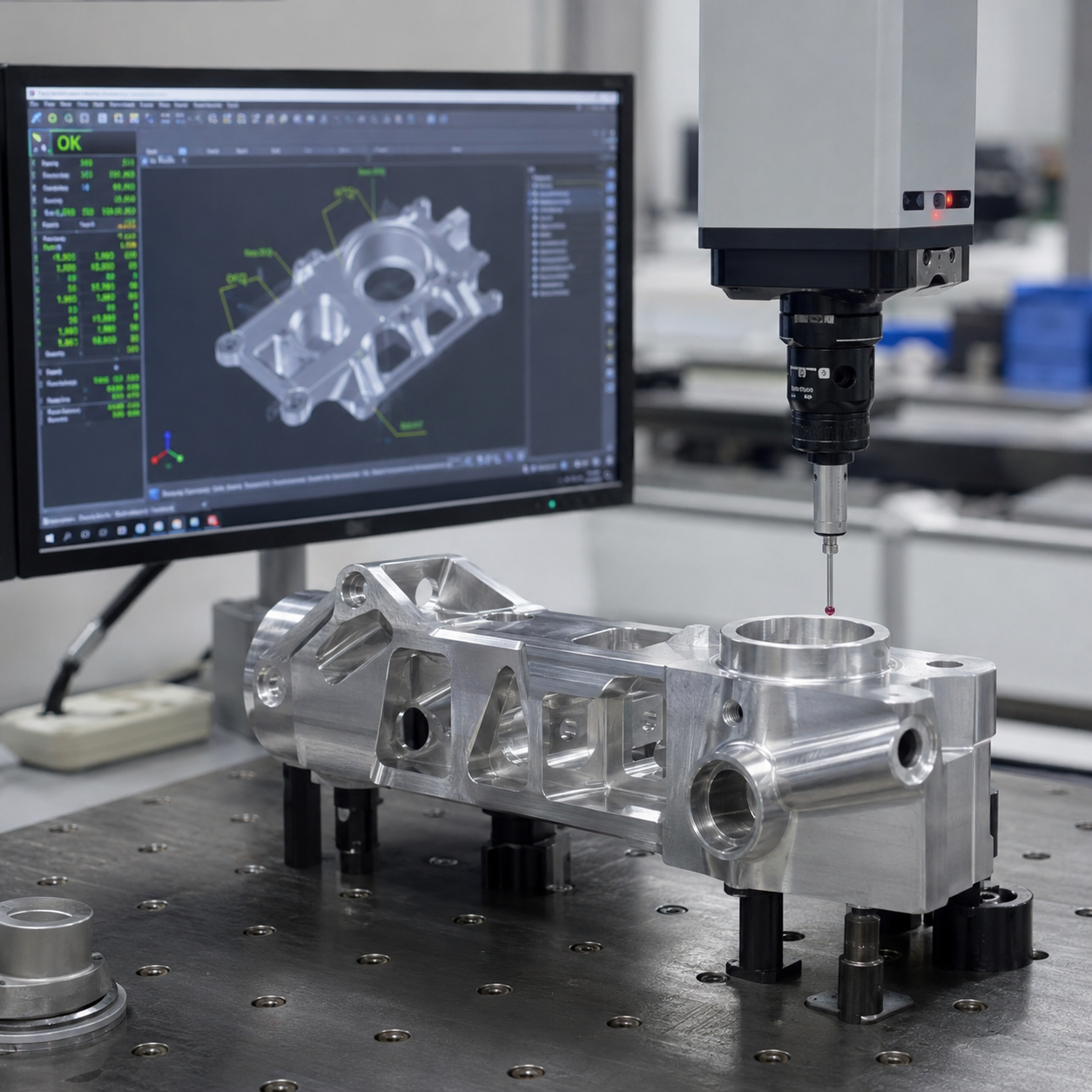
- CMM validation
- Statistical process control
How Does AS9102 First Article Inspection Support Aerospace Quality?
AS9102 First Article Inspection (FAI) verifies that:
- Drawings are correctly interpreted
- Manufacturing processes are validated
- Materials meet specifications
- GD&T requirements are achieved
The FAI process typically includes:
Step 1: Balloon Drawing Creation
Every design requirement is identified.
Step 2: Dimensional Verification
Critical dimensions are measured.
Step 3: Material Validation
Material certifications are reviewed.
Step 4: Documentation Review
Complete traceability is verified.
Aerospace Materials That Require Specialized Machining Expertise
Titanium Alloys
Common Grades:
- Ti-6Al-4V
- Grade 5 Titanium
Applications:
- Structural components
- Landing gear systems
- Engine parts
Inconel Alloys
Common Grades:
- Inconel 718
- Inconel 625
Applications:
- Turbine components
- High-temperature engine systems
Aerospace Aluminum
Popular Grades:
- 7075-T6
- 2024-T3
Applications:
- Aircraft structures
- Fuselage components
- Wing assemblies
Practical Example: Manufacturing an Aerospace Structural Bracket
Consider an aircraft structural bracket requiring:
- 7075-T6 Aluminum
- AS9100-compliant manufacturing
- Profile tolerance of 0.1 mm
- Position tolerance of 0.05 mm
- Complete material traceability
The workflow typically includes:
- Engineering review of ASME Y14.5 drawing
- Material verification
- CNC machining process development
- In-process inspection
- CMM validation
- AS9102 First Article Inspection
- Documentation package creation
- Final customer approval
This process ensures every part meets aerospace quality and safety requirements.
Why Aerospace OEMs Look for AS9100 and NADCAP Suppliers
Procurement teams increasingly evaluate suppliers based on:
- AS9100 certification
- NADCAP accreditation
- GD&T expertise
- 5-axis machining capability
- CMM inspection capability
- Traceability systems
- Capacity scalability
Suppliers possessing these capabilities are better positioned to support aerospace production programs and long-term contracts.
Key Takeaways
- AS9100 Rev D establishes aerospace quality management requirements.
- NADCAP validates special manufacturing processes.
- ASME Y14.5 defines GD&T standards for engineering drawings.
- Aerospace machining often requires tolerances tighter than ±0.025 mm.
- AS9102 First Article Inspection verifies manufacturing readiness.
- GD&T improves fit, function, and manufacturability.
- Aerospace OEMs prioritize suppliers with strong compliance and traceability systems.
- Precision machining, inspection, and documentation are equally important in aerospace production.
FAQ
What is the difference between AS9100 and NADCAP?
AS9100 focuses on the overall quality management system, while NADCAP validates specific manufacturing processes such as heat treatment, welding, and non-destructive testing.
Is AS9100 certification mandatory for aerospace suppliers?
While not legally mandatory, many aerospace OEMs and Tier-1 suppliers require AS9100 certification before approving a supplier.
What is ASME Y14.5 used for?
ASME Y14.5 provides the GD&T standard used to communicate engineering design requirements accurately on technical drawings.
What is AS9102 First Article Inspection?
AS9102 is a standardized process used to validate that a manufacturing process can consistently produce parts meeting engineering requirements.
Why is GD&T important in aerospace machining?
GD&T improves manufacturing consistency, inspection accuracy, assembly performance, and component interchangeability.
What materials are commonly machined in aerospace manufacturing?
Titanium, Inconel, stainless steel, and aerospace-grade aluminum alloys are among the most common aerospace materials.
Internal Linking Suggestions
- Aerospace CNC Machining Services
- 5-Axis CNC Machining for Aerospace Components
- Titanium Machining Challenges and Best Practices
- AS9102 First Article Inspection Explained
- Understanding GD&T in Precision Manufacturing
- Benefits of AS9100 Rev D Certification
- Aerospace Contract Manufacturing Guide
Conclusion
Aerospace manufacturing demands far more than precise machining. Success depends on a combination of disciplined quality systems, validated manufacturing processes, and accurate engineering communication.
AS9100 Rev D provides the quality framework, NADCAP ensures process integrity, and ASME Y14.5 establishes the language that engineers, machinists, and inspectors use to achieve precision. As aerospace programs become more complex and supply chains become increasingly scrutinized, manufacturers that invest in these standards will be best positioned to deliver reliable, compliant, and high-performance aerospace components for the future of aviation and defense.
.png)