On this page
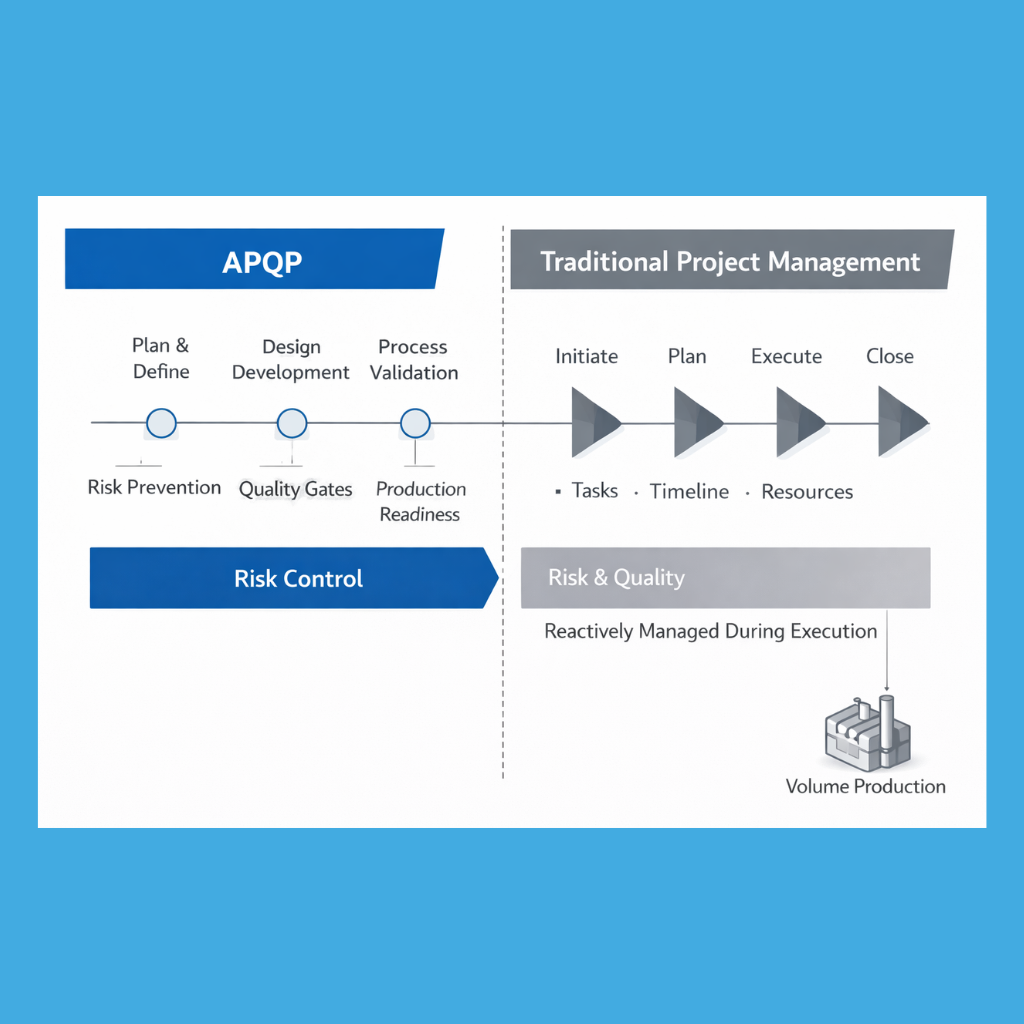
APQP and traditional project management address manufacturing execution in fundamentally different ways.
While traditional project management focuses on task completion and timelines, APQP is designed to control manufacturing risk, quality, and production readiness.
1. Core Objective and Focus
APQP (Advanced Product Quality Planning)
-
Risk prevention framework for manufacturing
-
Focuses on product quality, process capability, and production readiness
-
Identifies and mitigates failure modes before production launch
Traditional Project Management
-
Task and milestone-based execution framework
-
Focuses on schedule, resources, and deliverables
-
Risks are typically addressed reactively during execution
Key distinction:
APQP is quality- and risk-driven; traditional project management is schedule-driven.
2. Approach to Risk Management
APQP
-
Proactively identifies risks using structured tools
-
Emphasizes early-stage risk elimination
-
Manufacturing and quality risks are addressed before production approval
Traditional Project Management
-
Risks tracked as part of a general risk register
-
Manufacturing risks often surface during pilot or production
-
Mitigation is typically corrective rather than preventive
Key point:
APQP reduces late-stage failures by shifting risk identification upstream.
3. Manufacturing Readiness and Process Control
APQP
-
Validates process capability before volume production
-
Requires defined control plans and inspection strategies
-
Ensures repeatability across shifts, batches, and locations
Traditional Project Management
-
Assumes processes will stabilize during execution
-
Process validation may occur after production starts
-
Limited focus on long-term process control
Key point:
APQP ensures manufacturing stability before scale; project management often stabilizes after scale begins.
4. Quality and Compliance Orientation
APQP
-
Built around measurable quality deliverables
-
Requires documented validation at each phase
-
Strong alignment with regulated and high-risk industries
Traditional Project Management
-
Quality is treated as a deliverable, not a system
-
Documentation depth varies by team or project
-
Compliance is often handled separately from execution
Key point:
APQP embeds quality into execution rather than treating it as an outcome.
5. Cross-Functional Involvement
APQP
-
Integrates design, manufacturing, quality, supply chain, and procurement
-
Forces early alignment across functions
-
Reduces downstream rework and misalignment
Traditional Project Management
-
Functional involvement depends on project structure
-
Manufacturing and quality teams may be engaged later
-
Hand-offs increase interpretation and execution risk
Key point:
APQP minimizes hand-off risk through early cross-functional alignment.
6. Scalability and Production Transition
APQP
-
Designed to support repeatable scale-up
-
Emphasizes lessons learned and continuous improvement
-
Enables consistent performance across production volumes
Traditional Project Management
-
Success defined by project closure
-
Limited feedback loop into future programs
-
Scalability depends on individual team experience
Key point:
APQP supports long-term manufacturing scalability; project management focuses on short-term delivery.
7. When Each Approach Is Appropriate
| Situation | Preferred Approach |
|---|---|
| New product introduction | APQP |
| High quality or compliance risk | APQP |
| Volume production | APQP |
| One-time internal initiatives | Project management |
| Non-manufacturing programs | Project management |
| Low-risk, short-duration tasks | Project management |
Summary
APQP and traditional project management serve different purposes in manufacturing:
-
APQP controls quality, risk, and production readiness before scale
-
Traditional project management ensures task execution and timeline adherence
For manufacturing programs, APQP provides predictability, repeatability, and risk control that traditional project management alone cannot deliver.
How We Help
At Gate, we apply APQP principles alongside structured program execution to ensure manufacturing readiness, quality stability, and predictable scale-up across CNC machining, sheet metal, extrusion, and assemblies.
This approach helps OEMs reduce launch risk, avoid late-stage failures, and achieve consistent performance across production locations.
If you are evaluating suppliers or planning a new product launch, our engineering and quality teams can support you with APQP-led manufacturing execution.