On this page
Quick answer
-
Progressive die wins for high volume and small-to-medium parts with a stable geometry that can be carried by a strip through multiple stations.
-
Transfer die wins for larger or 3D parts that need to leave the strip between stations (deep draws, cups, shells), or when in-die ops get complex.
-
Line (single-hit) dies win for low volume, prototypes, service parts, or big/heavy parts where simple hits in standalone presses are enough.
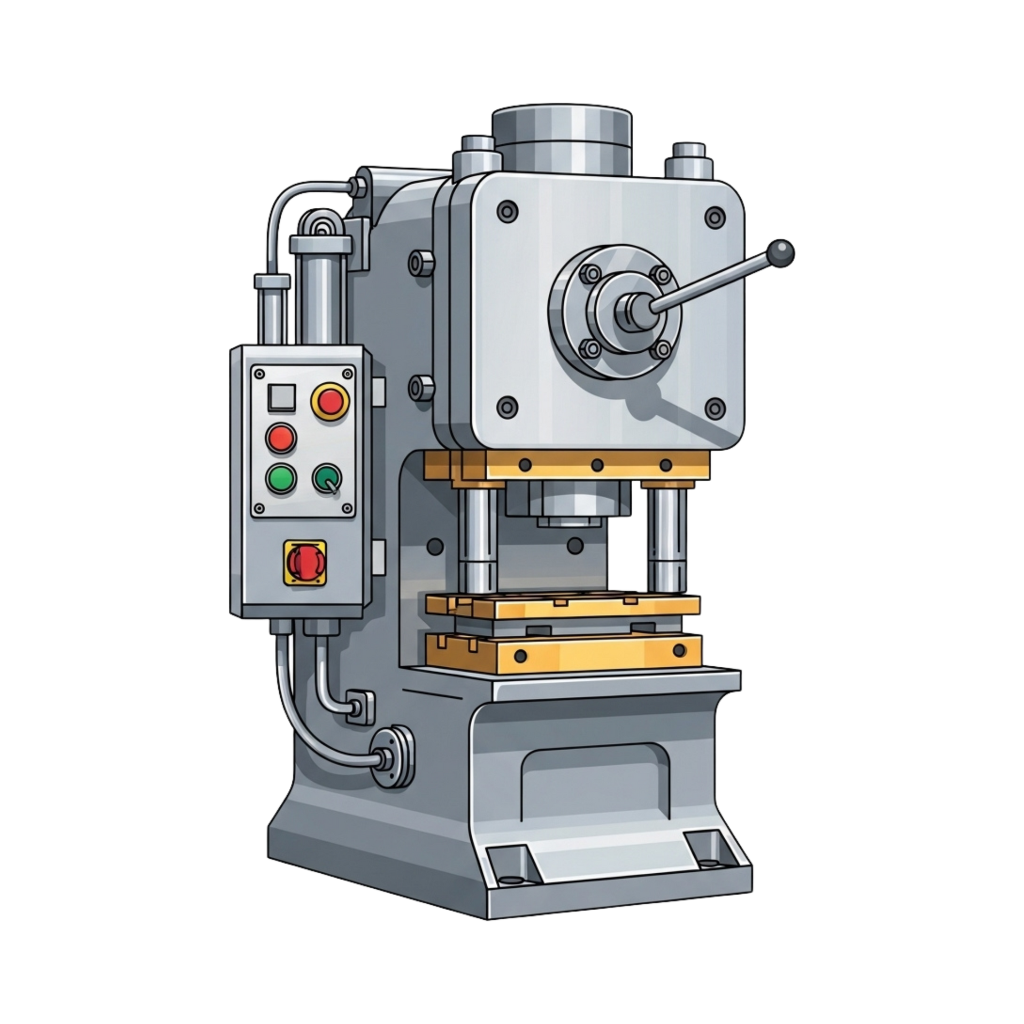
What is Progressive die, Transfer die, and Line die?
Progressive die
A coil-fed strip advances through many stations in one die: pierce, form, flange, coin, tap, final cut. Each press stroke makes one finished part. Best when the part can ride the carrier reliably.
Transfer die
A blank is separated early; mechanical fingers/robots transfer the part to separate dies for draw, re-draw, trim, flange, pierce. Ideal for deep, tall, or complex shells that can’t stay on a strip.
Line (single-hit) die
One operation per die/press. Operators or robots move parts station to station (e.g., laser blank → pierce die → form die). Low tool cost, high labor/cycle—great for short runs or oversized parts.
Comparison Between Progressive die, Transfer die, and Line die :
| Decision factor | Progressive die | Transfer die | Line (single-hit) die |
|---|---|---|---|
| Annual volume | Med–High (≥20k → millions) | Med–High (≥10k → hundreds of thousands) | Low–Med (1–20k, spares, pilot) |
| Part size/3D shape | Small/flat-ish, moderate forms | Large, deep draw, tall shells | Any, incl. very large/heavy |
| Tolerances & repeatability | Excellent; many ops in-die | Excellent; fixture control per die | Good; depends on handling/fixturing |
| Secondary operations in-die | Strong (taps, nuts, sensors) | Strong (draw + re-draw + trim) | Limited; done stepwise |
| Material utilization | High (tight nesting in strip) | Medium (blank nest + trims) | Variable; often more scrap |
| Change flexibility | Lower (carrier redesign) | Medium | High (swap a single tool) |
| Tooling cost | High upfront | Highest (multi-die set) | Lowest |
| Lead time to SOP | Longest (complex die build) | Long (multiple dies/tryouts) | Shortest (simple tooling) |
Guides only; your drawing and volumes decide.
Practical rules of thumb
Pick progressive when:
-
Annual volume justifies tooling and you want lowest part cost.
-
Part can stay in a strip (no tall walls colliding with carriers).
-
You want in-die features: coin, emboss, thread, nut/ stud insertion, vision sensors.
-
Strip layout gives good material yield.
Pick transfer when:
-
You need deep draws, multiple re-draws, or tall features that cannot ride the strip.
-
The part is larger or 3D and needs multiple forming dies to control flow.
-
You want robust fixture control per stage to hold critical forms.
Pick line (single-hit) when:
-
Volumes are low/variable, or the design is still changing.
-
The part is oversized/heavy (long rails, housings) where manual/robotic moves are fine.
-
You’re bridging from laser + brake to future hard tooling (pilot production).
Cost, lead time, and break-even (illustrative)
-
Tooling (very rough bands):
-
Progressive: $$–$$$$ (multi-station, cams, sensors)
-
Transfer: $$–$$$$$ (several dies + transfer fingers/EOAT)
-
Line: $–$$ (simple tools; can reuse standard punches/dies)
-
-
Lead time to SOP:
-
Progressive: 10–16 weeks (design → build → tryout)
-
Transfer: 12–20+ weeks (multi-die + EOAT)
-
Line: 2–8 weeks (simple tools/fixtures)
-
-
Break-even thinking:
If the per-part saving from progressive vs. line is ₹X and the tooling delta is ₹Y, then break-even ≈ Y / X parts. Past that, progressive wins. (We’ll run this math on your RFQ.)
Geometry & quality cues
-
Carriers & pilots (progressive): Ensure the part perimeter leaves enough carrier width; add pilots to lock pitch.
-
Draw radii (transfer): Respect draw ratios, radii, beads; plan re-draw stations.
-
Flatness & burr: Tighter burr control with sharp tooling and proper clearance; coining/ shave ops if needed.
-
Springback: Manage with radii/over-bend/beads/material choice; servo presses can help.
Materials and thickness (typical ranges)
-
CRCA / galvanized: 0.5–3.0 mm common across all three.
-
Stainless (304/316): Progressive with attention to galling; transfer for deep forms.
-
Aluminum (5xxx/6xxx): Watch springback; transfer for cups/shells.
-
High-strength steels: May push you to transfer or staged line ops to control cracking.
Example scenarios
-
EMI shield bracket, 0.8 mm CRCA, Qty 250k/yr: Progressive with pierce/emboss/coin; in-die nut.
-
Battery enclosure cup, 1.2 mm Al, deep draw, Qty 60k/yr: Transfer with draw → re-draw → trim → pierce.
-
Chassis rail, 2.5 mm GI, Qty 5k/yr: Line dies (pierce + form) or laser + brake; consider progressive later if volume scales.
RFQ checklist (so we can respond fast)
-
Models & drawings: STEP + 2D (DXF/DWG/PDF) with GD&T, material, thickness, grain direction.
-
Volumes: EOQ, annual forecast, and ramp plan (prototype → SOP).
-
Quality targets: burr, flatness, aperture tolerances; cosmetic sides.
-
Ops in-die: tapping, studs/nuts, emboss, coin, form, sensors.
-
Finish: plating, e-coat, powder, anodize; film build or hours.
-
Packaging: stack method, separators, VCI, labels, drop tests.
-
Approvals: PPAP/FAI, control plan, Cpk data, gauge plan.
-
Timeline: target SOP, PPAP date, pilot qty.
FAQs (quick answers)
Is progressive always the cheapest?
On piece price, usually, once volumes pass the break-even. Before that,the line often wins.
When do I need a transfer die instead of progressive die?
When the part can’t ride the strip (deep/tall forms) or needs re-draws and complex forms.
Can I start with line and move to progressive later?
Yes. Many buyers run laser + line tools first, validate demand, then invest in a progressive die.
Can you add fasteners in-die?
Yes—in-die nuts/studs or tapping are common in progressive and transfer dies.
Post your part photo/drawing below. Tell us material, thickness, and annual volume—we’ll reply with the best process and why.
Or upload your RFQ—we’ll run a quick break-even and get you a firm quote + lead time.