On this page
Material selection directly controls manufacturing cost, structural performance, and delivery timelines of metal components.
An inappropriate material choice can increase total part cost, create unnecessary strength margins, and extend lead times due to processing and supply constraints.
1. Material Selection and Manufacturing Cost
The total cost of a component is driven more by material behavior during manufacturing than by raw material price alone.
Cost factors influenced by material:
-
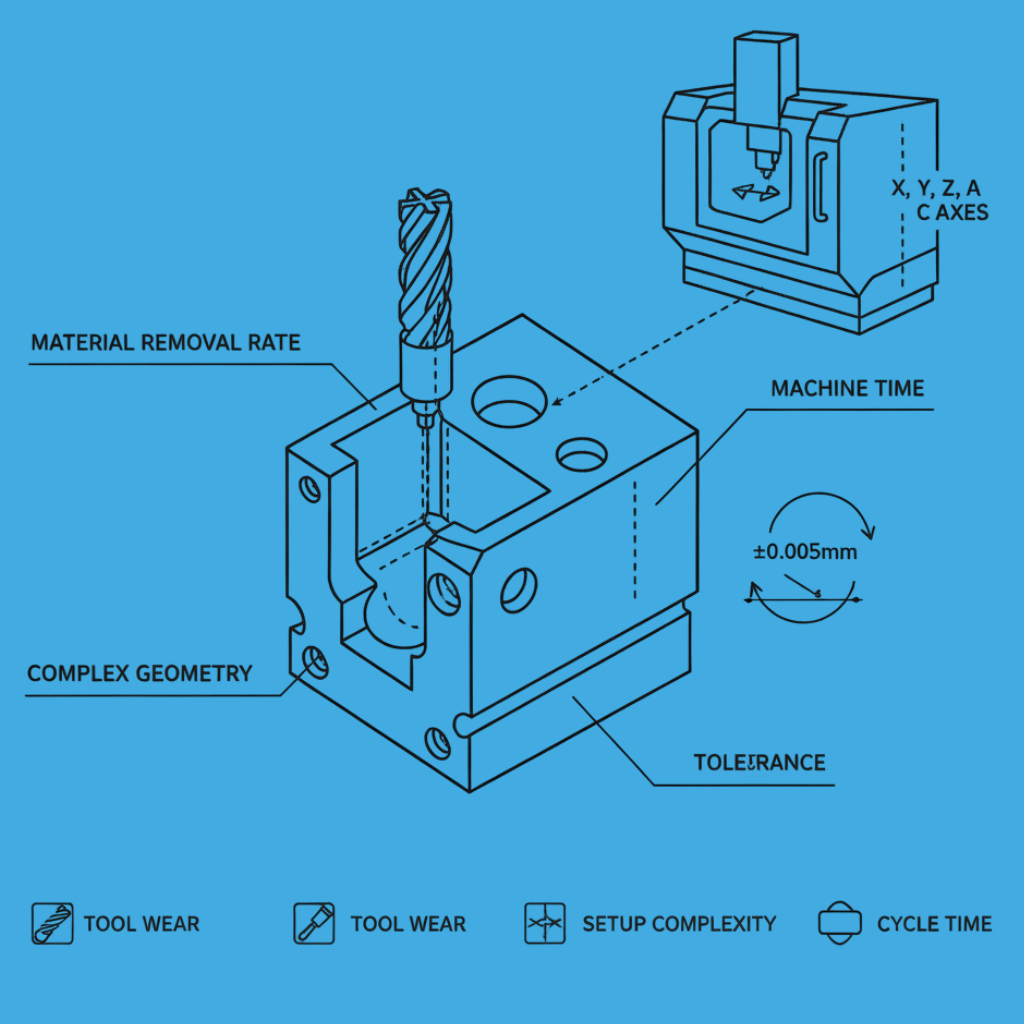
Machinability and cutting forces
-
Tool wear rates and tool change frequency
-
Forming or casting feasibility
-
Scrap generation and rework probability
-
Surface finishing and secondary processing
Technical implications:
-
Aluminium alloys typically reduce cycle time and tooling wear in CNC machining.
-
Stainless steels increase machining time, tool wear, and energy consumption.
-
High-strength steels may reduce section thickness but increase forming loads and tooling cost.
Key point:
Material cost must be evaluated as cost per finished part, not cost per kilogram.
2. Material Selection and Strength Requirements
Strength must be matched to actual load conditions, not maximum datasheet values.
Strength-related parameters affected by material:
-
Yield and tensile strength
-
Fatigue performance
-
Impact resistance
-
Creep and thermal stability
-
Corrosion resistance
Engineering considerations:
-
Aluminium alloys provide high strength-to-weight efficiency for structural components.
-
Carbon steel offers high load capacity but requires corrosion protection.
-
Stainless steel provides corrosion resistance but often exceeds structural needs for indoor or controlled environments.
Key point:
Over-specifying material strength increases cost and lead time without improving functional performance.
3. Material Selection and Lead Time
Lead time is influenced by availability, processing complexity, and supply chain maturity.
Lead time drivers linked to material:
-
Regional and global material availability
-
Minimum order quantities from mills
-
Tooling or die development requirements
-
Machining or forming cycle times
-
Heat treatment and coating processes
Practical impact:
-
Standard aluminium grades are typically available with short procurement cycles.
-
Specialty alloys may require mill production slots, extending lead times.
-
Imported or uncommon grades introduce logistics and compliance delays.
Key point:
Material availability often has a greater impact on delivery timelines than manufacturing capacity.
4. Cost–Strength–Lead Time Trade-Offs
Material selection requires balancing competing priorities.
| Requirement | Typical Material Strategy |
|---|---|
| Cost optimization | Standard carbon steel or aluminium |
| Weight reduction | Aluminium alloys |
| High structural load | Carbon or high-strength steel |
| Corrosion resistance | Stainless steel or treated aluminium |
| Short lead time | Locally available standard grades |
Engineering rule:
Select the lowest-complexity material that meets functional and environmental requirements.
5. Common Material Selection Errors
-
Selecting materials based solely on mechanical strength
-
Ignoring manufacturability and tooling impact
-
Overlooking finishing and coating requirements
-
Choosing low-availability alloys without supply validation
-
Finalizing material selection without manufacturing input
6. Practical Guidance for OEMs and Engineers
-
Define functional and environmental requirements first
-
Validate material availability at target production volumes
-
Involve manufacturing teams early in material decisions
-
Evaluate total manufacturing cost, not raw material price
-
Align material choice with process capability and geography
Summary
Material selection directly affects:
-
Cost through machinability, waste, and processing effort
-
Strength through appropriate—not excessive—performance
-
Lead time through availability and processing complexity
The optimal material is the one that delivers predictable manufacturing, reliable performance, and stable supply at scale.
How We Help
At Gate, we support OEMs and product teams by evaluating material choices alongside manufacturing processes, production volumes, and supply chain constraints.
Our engineering-led approach helps reduce cost, avoid over-specification, and ensure consistent lead times from prototype through full-scale production.
If you need support validating material selection for manufacturability, cost, or scalability, contact our engineering team.