On this page
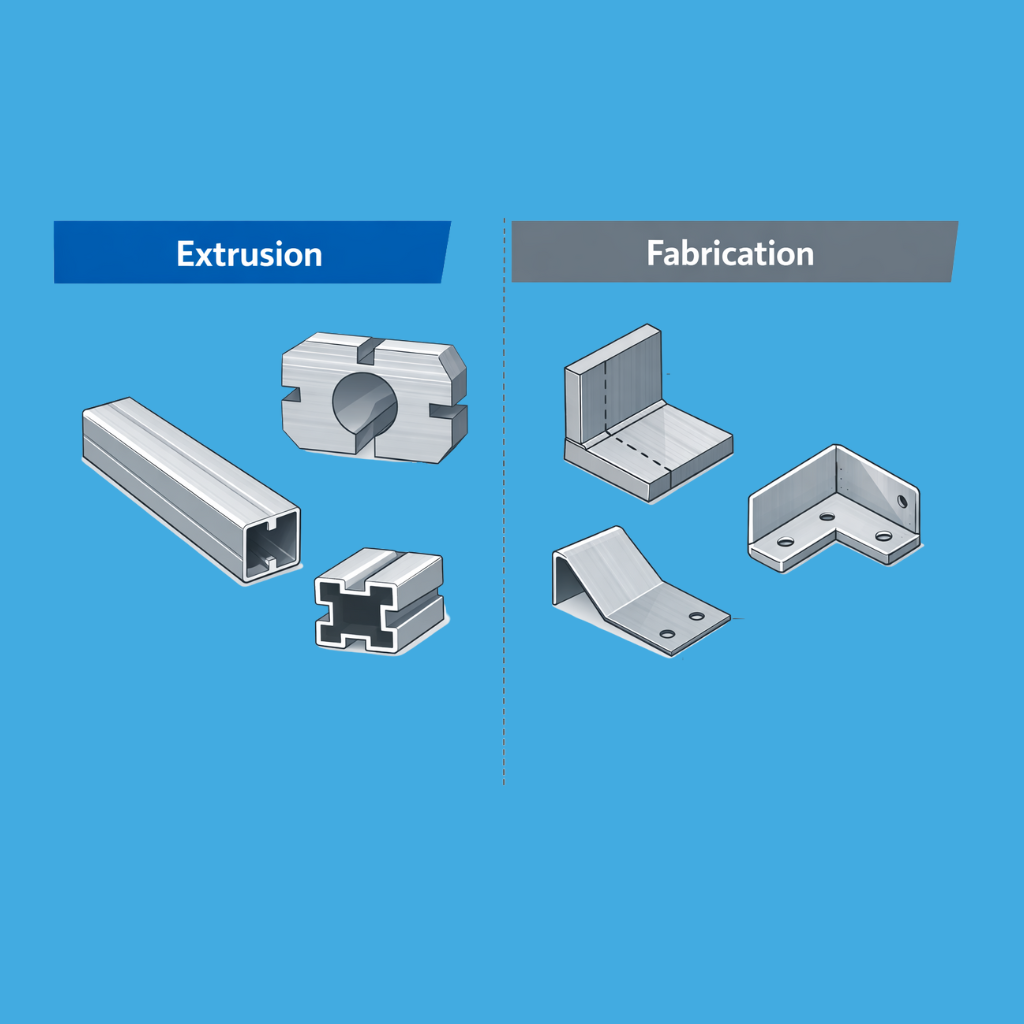
Extrusion and fabrication are fundamentally different manufacturing approaches with distinct implications for cost, structural performance, tolerances, and scalability.
Selecting the wrong process can increase part cost, limit structural efficiency, and constrain production scalability.
1. Process Definition and Manufacturing Method
Aluminium Extrusion
-
Continuous profile formed by pushing heated aluminium through a die
-
Produces uniform cross-sections along the entire length
-
Tooling-based process with high repeatability
Fabrication
-
Assembly of parts using cutting, bending, welding, and fastening
-
Allows variable geometry and non-uniform cross-sections
-
Relies on multiple operations and manual or semi-automated steps
Key point:
Extrusion is profile-driven; fabrication is operation-driven.
2. Cost Structure Comparison
Extrusion Cost Drivers
-
Die design and tooling cost
-
Profile complexity and wall thickness
-
Production volume and run length
-
Post-extrusion machining and finishing
Fabrication Cost Drivers
-
Number of operations and setups
-
Labor and welding time
-
Material utilization and scrap
-
Inspection and rework
Technical trade-off:
Extrusion has higher upfront tooling cost but lower cost per part at scale. Fabrication avoids tooling cost but carries higher recurring labor and handling cost.
3. Structural Performance and Strength
Extrusion
-
Uniform grain flow improves structural consistency
-
Enables optimized section geometry for stiffness and weight reduction
-
Limited to constant cross-sections
Fabrication
-
Structural performance depends on joint quality and weld integrity
-
Allows reinforcement only where required
-
Weld zones may introduce stress concentrations
Key point:
Extrusion delivers superior strength-to-weight efficiency for linear structural components.
4. Tolerances and Dimensional Control
Extrusion
-
Profile tolerances defined by die capability and alloy selection
-
Tight consistency along length
-
Secondary machining required for precision features
Fabrication
-
Tolerances accumulate across multiple operations
-
Welding and forming introduce distortion
-
Requires corrective machining or fixtures for precision
Key point:
Extrusion offers better dimensional repeatability; fabrication offers geometric flexibility.
5. Design Flexibility and Complexity
Extrusion
-
Complex internal features possible (channels, ribs, hollows)
-
No variation along profile length
-
Design locked after die finalization
Fabrication
-
Supports variable geometry and complex assemblies
-
Design changes easier to implement
-
Suitable for low-volume or evolving designs
Key point:
Fabrication is more adaptable; extrusion is more optimized.
6. Lead Time and Scalability
Extrusion
-
Initial lead time for die design and approval
-
Rapid production once tooling is validated
-
Highly scalable for medium to high volumes
Fabrication
-
Faster start for early-stage production
-
Lead time increases with complexity and volume
-
Scaling requires additional labor or automation
Key point:
Extrusion favors long-term scalability; fabrication favors short-term flexibility.
7. Typical Use-Case Guidance
| Requirement | Preferred Process |
|---|---|
| Constant cross-section | Extrusion |
| Low volume or prototypes | Fabrication |
| High volume production | Extrusion |
| Frequent design changes | Fabrication |
| High stiffness-to-weight | Extrusion |
| Complex assemblies | Fabrication |
Summary
Extrusion and fabrication involve clear technical trade-offs:
-
Extrusion optimizes cost, consistency, and structural efficiency at scale
-
Fabrication maximizes flexibility and design adaptability at lower volumes
The correct choice depends on volume, geometry stability, tolerance requirements, and lifecycle cost considerations.
How We Help
At Gate, we help OEMs and product teams evaluate extrusion versus fabrication based on part geometry, structural requirements, production volume, and downstream machining or assembly needs.
Our manufacturing-led assessment ensures the selected process delivers optimal cost, performance, and scalability.
If you need support selecting or transitioning between extrusion and fabrication for your components, contact our engineering team.