On this page
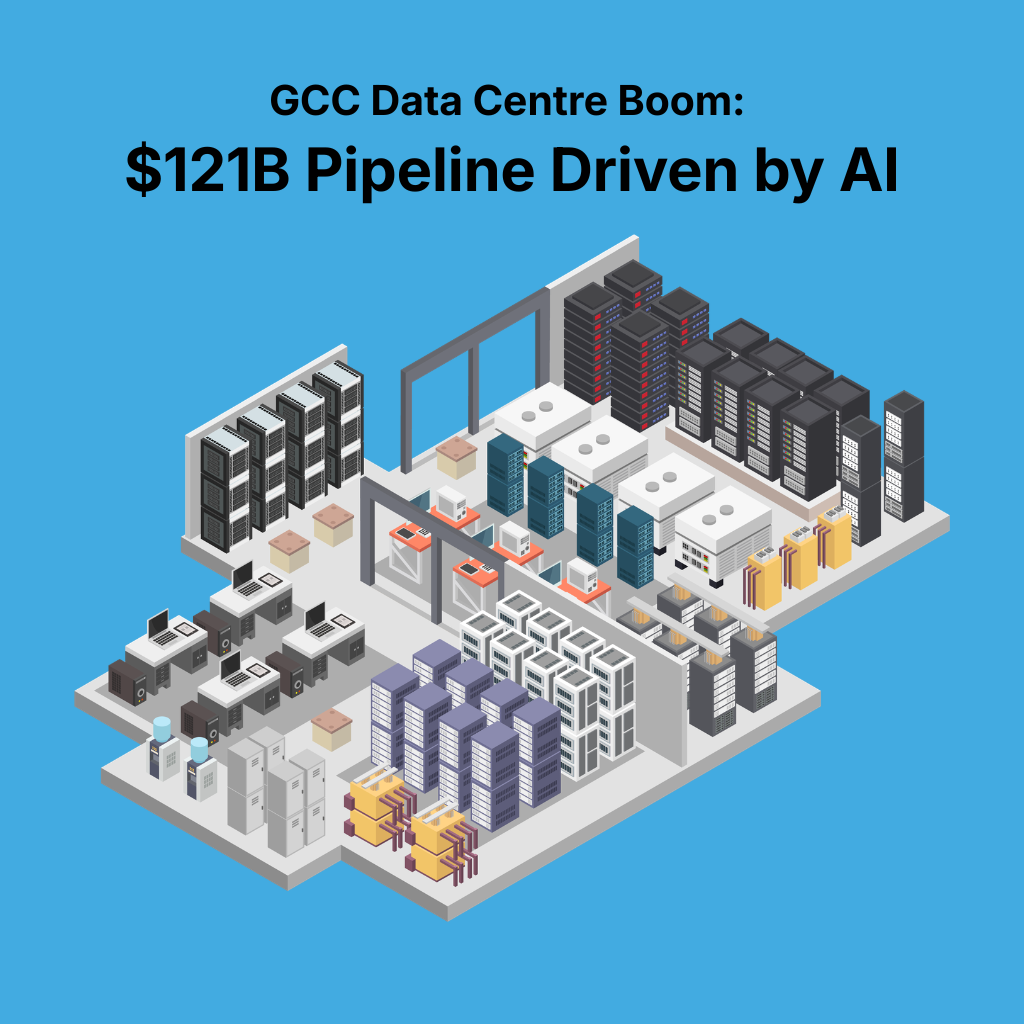
The GCC data centre market is entering a massive expansion phase driven by AI adoption, cloud computing, and digital transformation. With a project pipeline exceeding $121 billion, countries like Saudi Arabia and the UAE are leading hyperscale data centre development, creating major opportunities across infrastructure, power systems, cooling technologies, and industrial supply chains.
A decade ago, data centres were considered niche infrastructure.
Today, they are becoming national infrastructure — almost as critical as power plants or airports.
Why?
Because AI, cloud computing, and digital economies run entirely on data centres.
Across the GCC, governments and hyperscale cloud providers are racing to build new facilities to handle exploding digital demand. According to industry analysis, the region now has over $121 billion worth of data centre projects in the pipeline, with Saudi Arabia and the UAE leading the investment wave.
This transformation is not just a technology story.
It is a massive industrial and infrastructure opportunity.
What Is a Data Centre?
A data centre is a facility that houses computing infrastructure used to store, process, and distribute digital data.
These facilities contain interconnected systems including:
-
Servers
-
Storage systems
-
Networking equipment
-
Cooling infrastructure
-
Power supply systems
-
Security and monitoring systems
They act as the backbone of digital services, enabling cloud computing, enterprise applications, AI training, and big data analytics.
Without data centres, services like:
-
cloud platforms
-
AI models
-
streaming platforms
-
fintech applications
-
enterprise software
simply cannot function.
Types of Data Centres
Data centres are categorized based on ownership, purpose, and scale.
Enterprise Data Centres
Owned and operated by a single organization for internal workloads.
Colocation Data Centres
Third-party facilities that rent infrastructure such as space, power, and cooling to multiple companies.
Hyperscale Data Centres
Massive facilities used by companies like Amazon, Google, and Microsoft.
These typically exceed 100 MW of IT load capacity.
Edge Data Centres
Smaller facilities located close to users to reduce latency for applications like IoT and streaming.
Why the GCC Is Becoming a Data Centre Hub
Several structural factors are driving data centre investments across the Gulf region.
1. Rapid digital adoption
Internet traffic in Arab countries has grown significantly in recent years, with a 34% CAGR between 2019 and 2022, far above the global average of 22%.
2. AI and cloud expansion
Hyperscale companies need massive computing infrastructure to support AI training, cloud platforms, and data processing.
3. Data sovereignty laws
Governments in Saudi Arabia and the UAE increasingly require local hosting of sensitive data, forcing global cloud providers to build regional infrastructure.
4. Energy availability
The GCC offers access to large-scale energy infrastructure and low-cost power, which is essential for energy-intensive data centres.
5. Government digital strategies
Digital transformation programs, smart city projects, and AI initiatives are accelerating demand for local compute capacity.
The GCC Data Centre Pipeline: A $121 Billion Opportunity
The GCC currently has a data centre project pipeline worth approximately $121.4 billion.
Most of these projects are still in early stages:
| Project Stage | Share |
|---|---|
| Design phase | ~49.9% |
| Study phase | ~48.6% |
| Tendering | ~1.5% |
This means the majority of projects are yet to be built, creating long-term opportunities for contractors, equipment suppliers, and manufacturing partners.
Saudi Arabia alone accounts for about $80.7 billion of these projects, while the UAE holds roughly $40.2 billion.
Major Data Centre Projects in the GCC
Several landmark projects illustrate the scale of this infrastructure wave.
Project Stargate AI Campus (UAE)
One of the most ambitious projects is the Stargate AI campus, developed by Group 42.
Key specifications include:
| Specification | Value |
|---|---|
| Total capacity | 5 GW |
| First phase | 200 MW |
| Expected completion | 2029 |
| Cooling | Advanced liquid cooling |
| Rack power density | ~50 kW per rack |
The project will become one of the largest AI infrastructure hubs globally.
AWS Cloud Region – Saudi Arabia
Amazon Web Services is investing $5.3 billion to establish a new cloud region in Saudi Arabia.
Key characteristics include:
-
three availability zones
-
hyperscale architecture
-
AI-ready infrastructure
-
renewable energy integration
-
advanced cooling systems
The project supports Saudi Arabia’s Cloud First strategy and Vision 2030 digital economy plans.
Hexagon Data Centre – Riyadh
Another major project is the 480 MW Hexagon data centre complex announced by the Saudi Data & AI Authority.
Highlights include:
-
30 million sq ft facility
-
Tier IV architecture
-
estimated $2.7 billion investment
-
designed for government AI infrastructure.
The Industrial Supply Chain Behind Data Centres
Data centres may look like software infrastructure, but in reality they are extremely hardware-intensive industrial facilities.
A large data centre requires complex infrastructure systems such as:
Power Infrastructure
-
gas insulated switchgear (GIS)
-
air insulated switchgear (AIS)
-
transformers
-
backup generators
-
UPS systems and battery storage
Cooling Systems
-
liquid cooling
-
immersion cooling
-
HVAC systems
-
chilled water infrastructure
Digital Infrastructure
-
fibre networks
-
structured cabling
-
data centre infrastructure management systems
-
security and monitoring systems.
Because these components are long-lead and testing-intensive, they often dictate project schedules.
Why Manufacturing and Supply Chains Matter
The construction of hyperscale data centres creates massive demand for industrial components.
Typical infrastructure includes:
-
electrical enclosures
-
cable management systems
-
structural frames
-
cooling equipment housings
-
control cabinets
-
precision mechanical assemblies
In many projects, OEM electrical packages and cooling systems determine the master construction schedule because they require long manufacturing lead times.
This is why data centre developers increasingly prioritize:
-
regional suppliers
-
reliable manufacturing partners
-
local service and spare part availability.
Key Takeaways
-
The GCC data centre project pipeline exceeds $121 billion.
-
Saudi Arabia and the UAE dominate regional investments.
-
AI adoption and cloud expansion are the primary growth drivers.
-
Hyperscale projects often exceed 100 MW of IT capacity.
-
Major projects like Stargate and AWS Saudi Arabia are redefining regional digital infrastructure.
-
Data centre construction requires complex industrial supply chains involving power systems, cooling infrastructure, and precision manufacturing.
FAQ
Why are data centres growing rapidly in the GCC?
The growth is driven by AI adoption, cloud computing expansion, government digital strategies, and data sovereignty regulations requiring local hosting.
What is hyperscale data centre infrastructure?
Hyperscale facilities are extremely large data centres operated by cloud providers like AWS, Microsoft, or Google, typically exceeding 100 MW of IT load.
How much investment is planned for GCC data centres?
The GCC region currently has a pipeline of over $121 billion in planned data centre projects.
Why do data centres require so much power infrastructure?
Data centres operate thousands of servers that consume large amounts of electricity and generate heat, requiring complex power distribution and cooling systems.
Which countries lead the GCC data centre market?
Saudi Arabia and the UAE account for the largest share of projects and investments.
Conclusion
The rapid expansion of data centres across the GCC reflects a fundamental shift in how economies are built.
In the past, infrastructure revolved around ports, highways, and oil refineries.
Today, the new infrastructure of the digital economy is compute capacity.
As AI adoption accelerates and cloud platforms expand, hyperscale data centres will become the backbone of regional economies.
And behind every rack of GPUs or cloud server lies something less visible — but equally important:
A complex industrial ecosystem of power infrastructure, cooling technologies, precision manufacturing, and global supply chains that quietly powers the digital world.